Showing posts with label Australian politics. Show all posts

Wednesday, July 17, 2013

Follow the Leader

What you see depends on where you stand.
You know what I mean? If I sit at my desk, I can see the palm trees and the giant Moreton Bay fig in the yard. It’s a vista of rich green shapes that fills the window. But if I move about 5 steps to my boss’s desk, the green growth that fills my window is only a small part at the edge of his vision. He sees mainly blue-grey sky, grass, and beyond that, the river reflecting the mood of the sky.
Former Prime Minister Julia Gillard is in a very different place now to where she was just a month ago, and I imagine her view is very different from the back benches. More importantly, Ms Gillard’s view of the future has changed too. I don't know what it is that she sees, but I know it's different, because her perspective is different.
Kevin Rudd has been Prime Minister before, so the view is distantly familiar, but the environment and challenges are different.
Remember  that our views have changed too. Where a month ago our leader was a red-headed woman, it’s now a silver haired man. Change is emotional, for those involved and for those looking on. As a Change Manager, I should be aware of this, and in a professional capacity, I certainly am. As an observer and biased commentator on the political situation, I seem to be less astute.
There is still so much bad feeling lingering after the spill. I had thought that perhaps the Rudd fans who’d been so depressed after the June 2010 spill would have regained their equilibrium and be ready to get on with the job. Equally, I hoped that the Gillard supporters would accept that whether this year’s spill was right or wrong, warranted or not, restoring Rudd to the Prime Ministership has given the ALP a genuine opportunity to win the election and retain government.
The acceptance, the unity I was hoping for just isn’t evident. There is still pronounced ill-feeling, most of it aimed at Kevin Rudd. Those who supported Ms Gillard while Mr Rudd – in their opinion - destabilized the party and white-anted the leader refuse to forgive and forget. Some vow to boycott the ALP and vote Green. Others are still incoherent in their rage at what was done to our first female Prime Minister.
Perhaps we should take notice of how the Australian cricket team has behaved since their spill. South African-born coach Mickey Arthur was never well accepted by Australian cricket fans, so after a string of disappointing performances by the Aussies, Mr Arthur was sacked by Cricket Australia.
The Aussie fans were pleased to see the end of Mickey Arthur, particularly when he was replaced by Aussie bloke Darren Lehmann, better known to all as “Boof”. Boof doesn’t say much to the media. He gets results, and grotesque failure by the Aussie top and middle orders notwithstanding, we almost beat the Poms last weekend in the first Ashes test. No-one expected that.
Unlike politics, the cricket spill seemed to be surgically precise. Mickey was gone, Boof was in, and everyone was happy.
Except Dave Warner. And Mickey Arthur. And Michael Clarke and Shane Watson. First of all, Dave Warner, banished from the Australian team for two tests because of unacceptable off-field behaviour, admitted that his poor attitude and resulting booze-fuelled larks may have been a factor in the decision to give Mickey Arthur the boot. Very perceptive, Dave. Actions have consequences... but the coach failed to manage Dave's behaviour. I'm not making excuses for Dave Warner - he's old enough and experienced enough to know better - but when it became obvious that he had a problem, he should have been counselled and disciplined.
And now, Mickey Arthur is suing Cricket Australia for four million dollars, for wrongful dismissal. Now I don’t know what was in his contract, but if his employment was to coach the Australian team to victory, he failed in most of his objectives. If his contract included doing nothing to damage the reputation of the Australian cricket community, he failed on that measure as well as his team repeatedly made headlines for boozing, blueing, and failing to do their homework.
In his media statements, he has indicated that he was the hapless victim in a feud between Aussie Captain Michael Clarke and opener Shane Watson. Respected senior players like Brad Haddin are falling into line to support their team, denying any kind of contretemps between Pup and Watto. Boof, of course, has remained silent, as he should.
Whether there is or was any klnd of conflict between Pup and Watto is fascinating in light of Arthur’s claims. If there was no feud, Arthur is lying and looking for high profile scapegoats and a big payout. If there was a real feud, Arthur, as coach, should have intervened and managed the situation in whatever way was appropriate. In both cases, Arthur is wrong. I fail to see any "wrongful" in CA's dismissal of the former coach.
Mercifully, whatever had been going on within the Australian Cricket Team under Mickey Arthur is being dealt with, and team is behaving as a team (except for the regular batting catastrophes) and everyone, from fans to players to the Cricket Australia management group is united behind the bloke called Boof.
In the meantime, Labor supporters are still venting their bitterness all over social media. Julia Gillard isn't suing anyone for wrongful dismissal - she's got way too much class for that. In any case, if part of her role as parliamentary leader of the ALP was to lead the ALP to an election victory, she would have found herself soundly defeated. Another female Labor leader would be brought undone.
I understand that her supporters might abhor the way that Mr Rudd replaced Ms Gillard, but that’s done. My loathing is for the way she was treated while in the top job, but standing here at the boss's window, I can see that there was little option but to replace her. Continuing to focus energy on the spill appears as ALP disunity, and helps no-one. Ms Gillard's supporters need to move to a bigger window with a different view. It’s not Rudd versus Gillard that they should be seeing; it’s the Rudd versus the Coalition in the coming election and the view from that window is tinged with hope. 

Friday, June 28, 2013

CAAANBRA: Leadership

When I started writing on Wednesday morning, I was considering the loss of two independents from the Australian political scene and what it might mean for future independents. Now, I’m contemplating the loss of at least six remarkable Australian parliamentarians, and even more from the front bench.

Alongside the devastating loss is the restoration of hope – just a tiny shard of hope - that perhaps the good people from the Left can keep Tony Abbott out of The Lodge.

Bringing us this drama was a media that ranged from slick and innovative to angry and partisan.

Extraordinary Gentlemen

Australia is poorer as we contemplate a future without the calming influences of two true-blue gentlemen who for many years have steadied the daily drama within Canberra’s galleries of power.

For many, this hung parliament has brought out the worst: from the leadership instability within the ALP to the mean-spirited Liberal decisions around when they would or wouldn’t grant a pair, from the revelations about Craig Thomson and Peter Slipper to the accusations hurled across the floor, from the political convenience of benching former speaker Harry Jenkins to the empty sloganeering of Tony Abbott, we have seen some of the lowest behaviour imaginable.

Rob Oakeshott and Tony Windsor gave us the very best they have. They were elected as independents in traditional National Party heartland seats, but the actuality of the hung parliament elevated their roles beyond their electorates. To the disgust of some who thought they should behave as National Party stand-ins, both of these men realised the weight of their added responsibility and made their decisions accordingly.

Their retirements are a double blow to the integrity of our political system. Without the requirements of a political party to drive their vote, these remarkable men were free to vote for what they believed was right, instead of what was politically required. Every vote was a conscience vote.

Most memorable during this period of consistent negativity and nastiness is the dignity these two independents carried with them. Rob and Tony are the examples all of our politicians, all of us, should emulate. Regardless of the stresses of their positions, the daily frustrations and the torrent of malice directed their way, these gentlemen remained good humoured, honourable and humble.

It seems unfair that as independents, these two just walk out of public life. If they belonged to a political party, they’d be Elder Statesmen, choosing which Embassy they wanted to run for a few years. Instead, they go home, which I’m sure is what each of them wants.

Go well, gentlemen, with our thanks. You made a difference.


Spudd

In twitter style, each event gets its own hashtag to identify tweets which relate to that event. When Gillard toppled Rudd, it was #Spillard. Following that logic, last night’s leadership challenge should’ve been Spudd. But we all settled for #spill, it trended worldwide on and off for hours during the evening.

We know the story now: A petition was circulated to pressure Ms Gillard into calling a spill. Mr Rudd did not go to China. The spill was called for 7pm. Bill Shorten switched camps and voted for Rudd, as did Penny Wong. In fact, enough people changed sides to get Kevin Rudd over the line and back into the Prime Ministership. The best blow by blow description has been compiled by the ABC from Wednesday's tweets, mainly by ABC reporters.

Unfortunately, Mr Rudd’s victory is defeat for Australia’s first female Prime Minister. After the relentless attacks she’s had to endure, and the outstanding success she has had in reforming Australia’s education structures, introducing a price on carbon, brokering the MRRT, looking after the disabled in our communities and so much more, she deserves better than being dumped by the party that handed her the Prime Ministership.

Tony Abbott continues to describe the Labor Government as “dysfunctional”. It has certainly been entertaining, and I wouldn’t call it stable, but I can’t accept that a government which has achieved as much as this one has is dysfunctional. It’s highly functional, but like so much of the process of governing, it’s ugly. The best summation of the achievements of this Parliament is contained in Rob Oakeshott’s speech from earlier this week.

Prior to the vote on Wednesday evening, Julia Gillard and Kevin Rudd both confirmed that if they lost the leadership vote, they would resign from politics, ending the question of leadership. Julia Gillard did lose, and has confirmed that she will not recontest the safe Labor seat of Lalor, in Victoria. Sadly, some of Ms Gillard’s highest profile supporters have taken this a step further. Former Ministers Craig Emerson, Peter Garrett and Stephen Smith will not be recontesting their seats either.

Former Treasurer and ex-Deputy PM Wayne Swan will move to the back benches, where he’ll be surrounded by his former colleagues in the Ministry including Joe Ludwig, Steven Conroy and Greg Combet.

And still, Julia Gillard is the only woman to have resigned from Parliament this week.


Hate Media

I am sad, and more than a little scared at the likelihood of a future Australia under Tony Abbott, but I am appalled at the level of hatred in some tweets that have come from the right today. Not all conservative voters behave like undignified rabble on twitter, but some do – and some of them should know better.

Chris Kenny, a former Liberal political operative and journalist, now commentator for Sky News, tweeted


Get your dig in there Chris. It doesn’t need to be accurate or honest, just snarky and calibrated to benefit the Liberal Party, right?

Of course, you know that neither Oakeshott nor Windsor is leaving politics out of any desire to duck what Mr Kenny believes would be unacceptable results. People who can’t handle rejection well don’t go into politics. The truth is that Mr Windsor needs to manage some health issues and Mr Oakeshott is done. He’s been 17 years in politics and he’s done. Has Mr Kenny ever worked in the same job for seventeen years?

Sky News Australia has become Fox News Australia in all but name, and as the drama amplified yesterday, the conservative bias became more and more obvious. Paul Murray, whose show airs nightly at 9pm is setting himself up as Australia’s answer to Rush Limbaugh. He is an angry, bitter man filled with and fuelled by hatred for the Labor Party in general and Ms Gillard in particularly. His guests are almost exclusively from the right and further right, turning what was once a reasonably balanced news-chat show into the proverbial echo-chamber of simpering agreement.


Regular guests include former Howard Ministers Gary Hargraves and Peter Reith, Sky News colleague Janine Perrett, serial Gillard insulter Grace Collier, broadcaster Derryn Hinch, conservative (News Limited) columnist Janet Albrechtsen and her partner, Liberal Party has-been Michael Kroger, 2UE talkback colleagues Jason Morrison and John Stanley, economics writer for (News Limited’s) The Australian Adam Creighton, former Liberal Party staffer Chris Kenny, Andrew Stoner, leader of the NSW Nationals…and a light smattering of progressive guests like Peter Bentley of the McKell Institute and former Rudd staffer (and now MamaMia Mama) Jamila Rizvi, and current Labor MP Ed Husic plus some generalist commentators like PR pundit Prue MacSween and editor of the Australian Womens Weekly, Helen McCabe.

Sky News Australia should take notice of some of the comments that were floating on Twitter last night about Mr Murray’s performance. I don’t know if his preference for conservative-leaning guests is the result of an instruction from his employers, or is a personal choice to support the Opposition, but it’s obvious, and it’s far too close a Fox News clone for my liking.

Thursday, May 16, 2013

Just the Facts, Ma'am

Once upon a time, in a generation not too far ago, journalists were respected, news presenters were trusted, and politicians were at least, polite. Those were important times, easy times, when you could watch the news at six o’clock or seven o’clock or both, and you could believe what Brian told you.


Journalists were never in that same league of trusted professional as perennial winners nurses and paramedics, but they weren’t bundled in with the lowest of the low either.


Politicians were always a bit further down the list of trustworthy professionals than the journalists who reported their stories; they have a vested interest in telling people what the people want to hear. In this year’s poll of the most trusted professions, newspaper journalists, television reporters and radio talkback hosts were ranked 20, 21 and 22 respectively. Federal MPs ranked 25 and state MPs ranked 26…out of thirty. The only professions ranked lower than politicians were real estate agents, advertising people and car salesmen.

Poll upon poll, list upon list, the story remains the same. Journalists aren’t trusted much more than the politicians they report on. How do you know who to trust? Paul Murray on Sky News promises to tell you what “really happened”, Bill O’Reilly refers to his show, The O'Reilly Factor, as the “the no-spin zone” and our own ABC News tells us that they’re “more than the headlines”. And that’s just television.

Please don’t take this the wrong way; I’m not suggesting that the fourth estate is unrelentingly shonky. The miserable fact is that enough reporters have been untrustworthy enough to build a perception that we should question the news we’re provided. High school students are being taught to be critical consumers of news. Scepticism is hardly surprising in an global news environment dominated by Rupert Murdoch's right wing Fox News and bumbling CNN on one side of the Atlantic and the now-defunct News of the World and the rest of Murdoch’s News International on the other.

And what of Australia’s media? More Murdoch, a relatively small population and a ridiculously high concentration of media ownership makes for easy targets and large ripples. If you control the media in Australia, you control the Australian agenda.

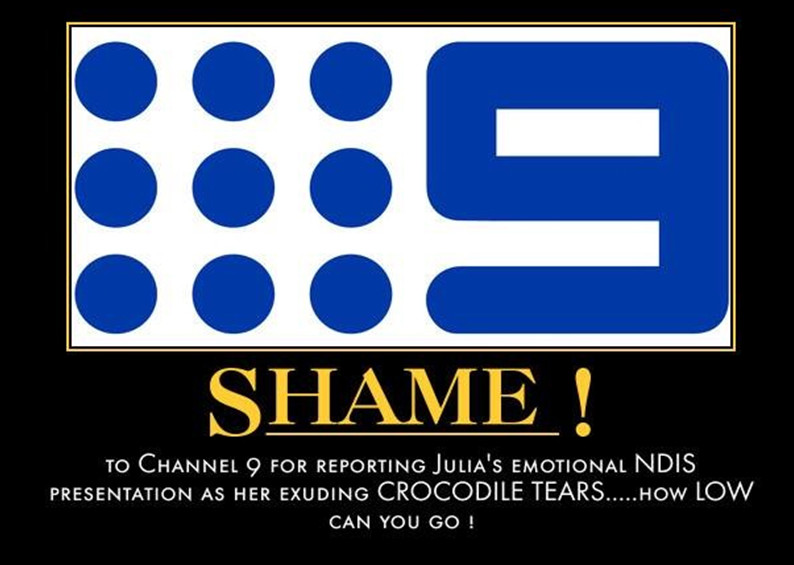
Never was that more evident that in the reporting of our Prime Minister crying in parliament yesterday. news.com reported the tears as being the result of stress, until Sky News’s David Lipson tweeted a card from some of Queensland’s disabled population, thanking the Prime Minister for making the NDIS a reality. But of course, News Limited’s first instinct was to show Ms Gillard being weak, rather than showing her being compassionate. They interpreted what they saw and reported it through their lens of right wing negativity.


And what are we talking about today? Julia’s tears, of course. 612Brisbane’s breakfast producer Anne Debert was not impressed with Ms Gillard’s tears, yet couldn’t explain why it annoyed her so much. The fact is, we are talking about whether it’s appropriate to cry in the workplace, whether it’s a gender issue, and if it is, is it one we should embrace, or one which deserves censure. How has this become the talking point of budget week? Most of our news outlets have led with stories of the PM being “reduced to tears" or “driven to tears” or even “moved to tears” rather than discussion of the Federal Budget, the actual DisabilityCare scheme, or any of the other valid news stories of the day.

And before anyone makes the obvious gender related gags, allow me to remind you of Bob Hawke, crying on television during an interview about his private life and again, during the Tiananmen Square massacre in 1989. Malcolm Fraser cried the night the Liberals lost power in 1983. Kevin Rudd cried the night Ms Gillard replaced him as Prime Minister. There’s a long tradition of Prime Ministerial waterworks in this country and beyond. The Sydney Morning Herald chronicled just some of it in 2010, after Mr Rudd’s final press conference as PM, and observed then:
It seems we have finally come to accept such outbursts of emotion from our male political leaders as displays of genuine human feeling. And yet, for many women in business life, crying is still seen as a sign of weakness.

If the tear ducts of our first female prime minister runneth over at any point, I wonder: will it be interpreted as weakness or strength of character?

I love that the question was asked, for runneth over they did. Few media types attributed it to weakness, though. Initially, it was reported as a reaction to stress; later, as compassion, and more recently, opinion writers have written their defence of tears. 
National Nine News seems to have an opinion on tears.

So where does that leave us, the news consumers who don’t have a front row seat and rely on the accuracy and objectivity of news professionals to keep us informed? With the federal election now less than four months away, is it even possible that votes will be decided on the basis of whether the tears of the PM are conveyed as a strength or a weakness? Why are we talking about this, when it's not even the first time Prime Minister Gillard has shed a tear in the house?

The millions of choices made every day by our news media about which word to use here and what tone is needed there will influence the votes of many Australians. Like Anne, you might not be all that keen on a teary PM, but if those tears are reported as a sign of emotional fragility, it could be a vote changer for some. If the report suggests it’s a sign of strength and compassion, different votes might change.

A vote or two here or there won’t make a difference, and isn’t that the beauty of democracy? If you change enough minds, you change a result. The consistent messages - just a few words, or a blaring headline supporting the Coalition - has continued over three years now, and has thrived during this hung parliament. A daily avalanche of negative spin will change minds.

This stuff matters.

Some get it right, some don’t. American Democrat and sociologist Daniel Patrick Moynihan said, “You are entitled to your own opinion. You are not entitled to your own facts.”
From PolitiFact's American election coverage in 2012


Apparently that’s not entirely true any more; it seems that the Climate Change Denialists like the Galileo Movement are entitled to make up their own “facts” – but 97.1% of peer reviewed scientific papers still agree that climate change is real and we’re making it worse.
All of which leads us to PolitiFact Australia, the first international incarnation of the Pulitzer Prize-winning American fact-checking website. According to their own website:


PolitiFact Australia is a non-partisan, independent journalistic venture run by Peter Fray, the former editor-in-chief of the Sydney Morning Herald, and staffed by experienced reporters and researchers.

Our goal is to bring greater accountability to the federal election campaign.


We want to help Australian voters make better-informed decisions.


We want to help keep our politicians honest.


We want to restore faith in the political process — and the role journalists play in it.


Journalists exist to hold the powerful to account. PolitiFact in the US and now in Australia is an affirmation of that deep tradition.
I’d like to proclaim publicly my support for our truthy new overseers, but you see, there’s this pesky thing called Social Media which is making life interesting for politicians and journalists, and now for PolitiFact Australia. Their judgment has already been questioned on social media.
And isn’t that how it should be? In a mature society we should hold eachother to account. In fact, we should strive for a higher standard? When, for whatever reason, the news media falls for the line which today’s politician is peddling, we have a team of professionals who are spending their discretionary time checking facts…and if they get it wrong, social media will let them know it.

The world will change, just a little, for those paying attention.


All of these images were borrowed from social media: thanks to those who created and posted them.